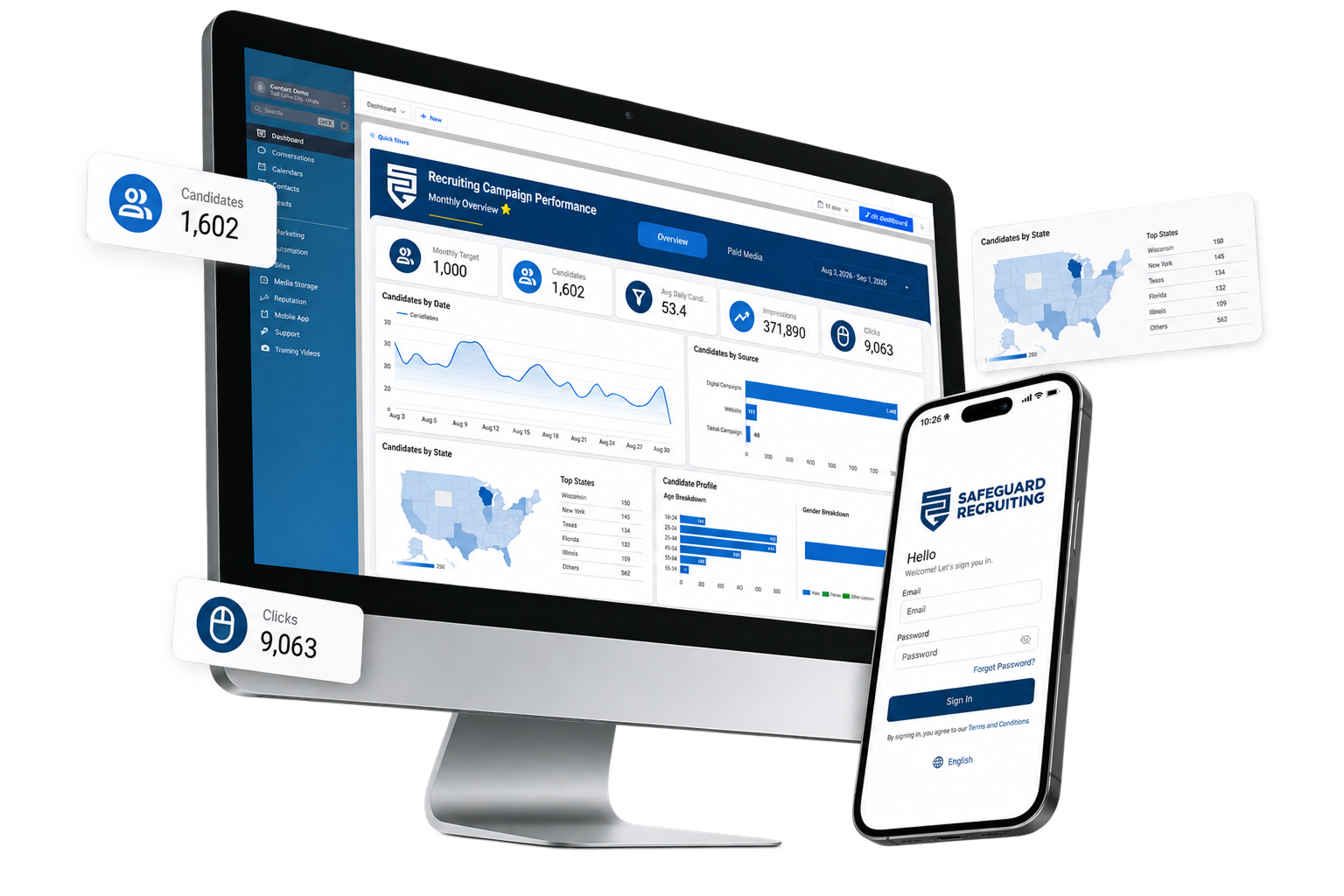


Police recruiting is not a checkbox assignment you hand off to the next available sergeant. Over the past decade, we’ve seen departments civilianize many support functions, such as policy management, media relations, and data analysis, with good reason. Recruiting needs that same rethink. When recruiting is treated as “extra duty,” agencies lose consistency, speed, and the specialized skills needed to build a steady pipeline of qualified candidates.
Police Recruiting Is a Specialized Job, Not an Assignment
People join law enforcement to do law enforcement. That’s the point. But police recruiting is a different craft. In the private sector, organizations either have full-time in-house recruiting experts or hire specialists. Why? Recruiting requires constant attention to technology, ad placement, messaging, tracking, and compliance. Expecting a newly-assigned sergeant to juggle all of that on top of patrol or administrative duties is unrealistic.
The reality: departments excel at explaining the job, prepping candidates for tests, and setting up ride-alongs. They struggle with candidate generation, modern sourcing channels, and conversion tactics that turn interest into applications.
Outsourcing Parts of the Recruiting Cycle
Outsourcing doesn’t mean giving up control. It means bringing in specialized expertise to handle discrete parts of the cycle, sourcing, ad placement, lead nurturing, and initial applicant communication, so internal recruiters can focus on what they do best: vetting, testing, and onboarding.
Departments are increasingly hand off elements like:
- Candidate generation and sourcing.
- Ad development and placement across social and job platforms.
- Automated messaging to keep candidates engaged through the application.
- Analytics to forecast volumes, conversion rates, and hires.
What Departments Do Well — And Where They Need Help
Law enforcement teams are great at the human side of recruiting: interviews, fitness prep, academy guidance, and representing the department’s culture. Where many departments fall short in police recruiting is in consistent outreach and modern candidate communication.
Common internal roadblocks:
- High turnover of assigned recruiters due to transfers and promotions.
- Limited time and resources to learn constantly changing ad platforms and algorithms.
- Overwhelm when hundreds of candidates respond at once, leading to slow or no follow-up.
The 80/20 Rule: Focus the Expertise Where It Matters Most
In practice, roughly 70–80% of applicants will show up without elaborate outreach. They want to be police officers and will apply when an opening exists. The critical 20–30% are the candidates you need to reach with a targeted strategy and persistent nurturing. That smaller slice often contains the higher-quality applicants who require a sophisticated outreach approach.
Could this be why many agencies are experiencing shortages of 20% plus?
Expecting a brand-new recruiter to master sourcing, ad optimization, compliance, and continuous messaging overnight is unrealistic. Specialists accelerate that learning curve or eliminate it entirely by delivering predictable, scalable pipelines from day one.
Cost, ROI, and a Real Example
Price is a common concern, but consider what it costs to staff up a full-time recruiter or a recruiter team? Multiply that by the overtime caused by understaffing.
The Phoenix Police Department recently said it spent $98 million in overtime last year, and the majority of that was due to staffing shortages. The problem is not unique; here is a quick example of an officer with one recruiter who is currently down 50 officers.
Cost of an officer: $50,000
Cost of annual overtime: $1 million+
The average cost to source each hire annually is approximately $1000 per officer, so this agency could be fully staffed for around $50,000.
Meanwhile, they spend millions each year just to fill the beats.
In the Phoenix police situation, they are down 500 officers, so they could fix the issue for $500,000.
This is not hyperbole, but from our data and our successes across the country.
Bonuses vs Messaging: What Really Drives Applicants
Many agencies believe big signing bonuses are the key to solving staffing gaps. Experience shows otherwise. Whether a department offers large bonuses or none at all, targeted messaging and consistent outreach produce applicants. What matters is how you tell your story, where you place your message, and how you follow up.
In short: compensation matters, but it’s not a silver bullet. Messaging cadence, platform selection, and timely communication do the heavy lifting.
How a Recruiting Partner Operates
A strong recruiting partner brings:
- Predictable volume guarantees so departments can plan Academy slots and budgets.
- Automated engagement flows that keep candidates moving from interest to application.
- Filtering and qualification so police recruiting managers see ready-to-interview candidates.
- Data-driven reporting on conversion rates from ad click to hire.
Candidates with law enforcement experience add credibility and operational insight to police recruiting. They can point out process weaknesses, suggest improvements, and sometimes recommend changes that speed police recruiting and hiring without charging extra for the advice.
Actionable Steps for Departments
- Audit your current police recruiting process and identify where candidates are dropping off—sourcing, initial contact, application completion, or pre-hire communication.
- Decide which pieces you want to keep in-house (testing, academy prep) and which to outsource (sourcing, paid ads, automated nurturing).
- Evaluate potential partners by asking for track record, law enforcement experience, and sample ROI calculations based on your historical conversion rates.
- Start small with a pilot campaign to validate volume, conversion, and cost relative to overtime and hiring bonuses.
- Use data to scale: if a partner can reliably deliver applicants that meet your qualifications, scale the engagement to match your staffing needs.
Final Thought
Treat police recruiting like the specialty it is. Whether you build a full-time, expert recruiting team internally or partner with a law-enforcement-focused recruiting firm, the goal is the same: predictable pipelines of qualified candidates, reduced overtime costs, and faster academy fill rates. This is achievable with the right partner and the right process.
If you want to talk through options on police recruiting or get a realistic estimate for your department, reach out at SafeguardRecruiting.com.
Academic Source:
Wojslawowicz, A. N., Payne, J. S., Gibson, A., & Cherry, W. T. (2024). ‘I really felt wanted’: Police recruitment strategies within a competitive labour market. Policing: A Journal of Policy and Practice.
Link: https://academic.oup.com/policing/article-abstract/doi/10.1093/police/paae003/7609896