

Police hiring has entered a new era, and the agencies that adapt first will win the shrinking talent pool. Candidates live on their phones, expect immediate answers, and move on quickly when a process feels outdated or slow. That’s why AI for police recruiting is no longer a futuristic concept. It is quickly becoming the backbone of modern public safety hiring, helping agencies respond faster, communicate more effectively, and remove friction at every step of the pipeline.
AI for Police Recruiting
The best way to think about AI is simple: it is a force multiplier. It doesn’t replace recruiters. It removes the repetitive workload that prevents recruiters from doing what matters most: talking to people, building trust, and assessing character. Used correctly, AI for police recruiting strengthens the human element by eliminating the “silent” periods when good candidates disappear.
Start with the front door: your recruiting website. If your site is hard to navigate, slow to load, not accessible to the AI engines, or not built for mobile, you’re losing applicants before they ever raise their hand. Website accessibility is a major part of modernization, and it’s a practical hiring issue, not just a compliance checkbox. Candidates should be able to find requirements, pay, benefits, timelines, and disqualifiers in seconds, even when asking their preferred AI bot. An accessible, mobile-first site paired with AI for police recruiting can also personalize what a candidate sees based on their interests, such as patrol, investigations, or lateral opportunities.
Next, add an always-on assistant: chatbots. A candidate who asks a question at 3 a.m. should not have to wait until Monday to hear back. Chatbots can answer common questions instantly, guide candidates to the right next step, and capture lead information when someone is interested but not ready to apply. This is one of the easiest wins for AI for police recruiting because it addresses the single biggest killer of applications: delay. If your agency’s response time is measured in days, you are losing people to departments that respond in minutes.
Automation is the connective tissue that keeps candidates moving forward. Many agencies still rely on manual follow-ups, scattered spreadsheets, and inbox-based workflows. That’s a recipe for missed contacts, inconsistent messaging, and candidate drop-off. With workflow automation, every lead can receive a structured communication sequence that includes confirmation messages, next-step instructions, reminders, and check-ins. This is where AI for police recruiting becomes operational. It ensures that every candidate receives timely communication, even when your recruiting team is overwhelmed.
AI can also improve screening and prioritization. Not by making final decisions, but by organizing information more quickly and consistently. For example, AI can help categorize leads as entry-level, lateral, military-to-civilian, or dispatcher-to-officer pathways. It can flag incomplete applications, identify candidates who have gone cold, and recommend a recruiter call when a lead shows high intent. In other words, AI for police recruiting can help your team focus effort on areas that will produce hires, not just activity.
Another overlooked advantage is support for interviews and testing. AI tools can automatically schedule interviews, confirm attendance, and send candidates prep materials so they feel confident and informed. That reduces no-shows and improves candidate experience. AI can also automate status updates, so candidates aren’t left wondering what happened after they submit an application. When applicants feel ignored, they assume they’re not wanted. AI for police recruiting helps eliminate that damaging perception.
Of course, none of this works if your process still has unnecessary barriers. If your application takes an hour, requires a desktop computer, or is packed with confusing steps, AI won’t fix the problem. AI should be integrated into a simplified hiring pipeline designed to convert interest into action. That includes mobile-friendly forms, clear calls to action, fast acknowledgements, and a consistent communication plan. The goal is not to be high-tech for the sake of it. The goal is to remove friction, increase speed, and build trust.
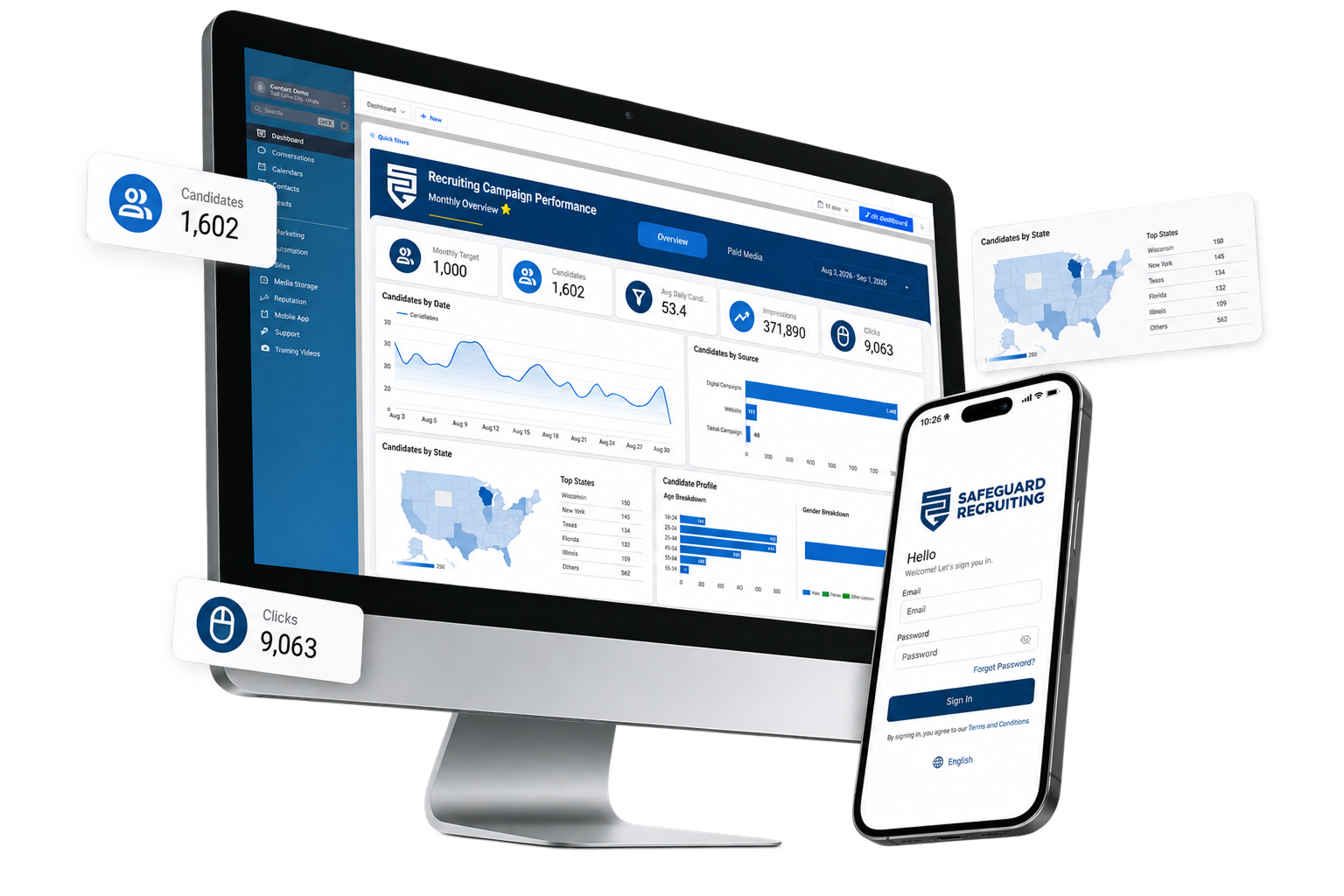
The final point is critical: AI must be incorporated into the hiring process, not bolted on as a separate gadget. That means connecting the website, chatbots, recruiting, and applicant tracking system (like SAFEGUARD Connect), and communication tools into a coordinated system. When AI for police recruiting is fully integrated, every candidate interaction becomes trackable, measurable, and improvable. You can see where candidates drop off, which messages drive completions, and which sources produce the best hires.
Agencies that ignore these tools will continue to fight the same losing battle: fewer applicants, slower pipelines, and recruiters stuck doing clerical work instead of recruiting. Agencies that embrace AI for police recruiting will move faster, communicate better, and compete like modern organizations. The best time to modernize was years ago. The next best time is now.
SAFEGUARD Recruiting has pioneered AI for police recruiting. We are former public safety officers who understand the balance between technology and the human touch in recruiting. We’ve also tested hundreds of public safety recruiting sites, and 95% of them are not set up for AI accessibility. That means when someone asks about your agency, someone else is telling them about it and not you.
To find out whether you are AI-capable, reach out, and we will let you know.
Academic Source:
Chen, Z. et al. (2022). “Collaboration among recruiters and artificial intelligence.”