

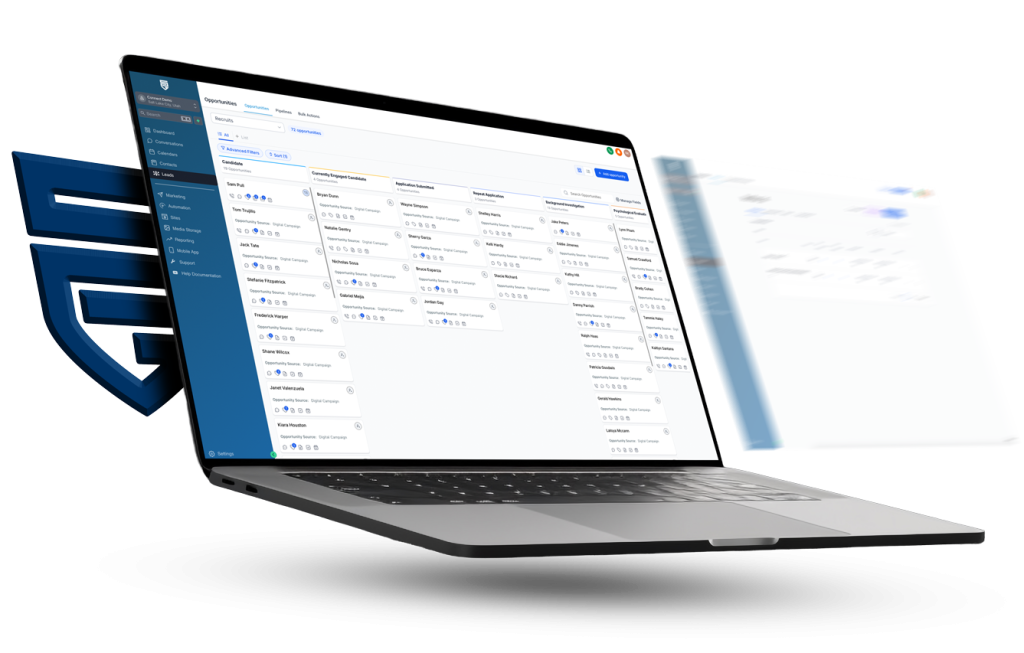
If your agency is still managing recruiting through spreadsheets, email chains, and sticky notes, you are losing candidates to departments that are not. Applicant tracking software has become one of the most important investments a law enforcement agency can make in 2026 and beyond. The departments that understand this are filling academies.
This is not a technology trend. This is about survival.
The Recruiting Crisis No One Can Afford to Ignore
Law enforcement agencies across the country are facing a staffing emergency that shows no signs of slowing down. According to the Police Executive Research Forum, more than 47 percent of agencies reported a decrease in the number of applicants over the last five years. Retirements are outpacing new hires. Lateral candidates are being aggressively courted by competing agencies. And the qualified applicant pool is smaller than it has ever been.
Traditional recruiting methods were built for a different era. Job fairs, word of mouth, and paper applications made sense when there were more candidates than seats. That world no longer exists. Agencies need law enforcement recruiting strategies that match the speed and expectations of today’s applicants, including millennials and Gen Z officers, who expect a seamless digital experience from the first click to the first day on the job.
Applicant tracking software gives agencies the infrastructure to compete.
What Applicant Tracking Software Actually Does for Law Enforcement
Applicant tracking software is not simply a place to store resumes. For law enforcement agencies, a purpose-built platform organizes every stage of the recruiting pipeline, from the moment a candidate sees your job posting to the day they receive a conditional offer.
Here is what strong police recruiting software does in practice.
It Centralizes Every Applicant in One Place
Agencies that rely on email and manual entry lose candidates between the cracks every single day. A dedicated applicant tracking system for police forces centralizes every candidate profile, test score, interview note, background check status, and document in a single dashboard. No more searching through inboxes. No more asking which sergeant interviewed which candidate.
It Automates the Follow-Up That Recruiters Forget
One of the top reasons candidates drop out of law enforcement hiring pipelines is the lack of communication. Applicants move on when they do not hear back. Applicant tracking software sends automated status updates, interview reminders, and next-step notifications to keep candidates engaged and informed throughout the process. This single feature alone has a measurable impact on completion rates. As Doug Larsen, CEO of Safeguard Recruiting, often says, “If you don’t communicate, this generation of candidates believes you don’t care.”
It Gives You Data You Can Act On
Modern public safety recruiting solutions include reporting dashboards that show you where candidates are dropping out of your pipeline, how long each phase takes, which recruiting channels are driving the best applicants, and how your time-to-hire compares across job classifications. This is the kind of intelligence that lets a recruiting sergeant walk into a chief’s office with a strategy instead of a guess.
It Supports Compliance and Background Tracking
Law enforcement hiring is heavily regulated. Applicant tracking software built for public safety keeps your documentation organized, tracks required steps, and creates an auditable record that protects the agency legally. This matters when a hiring decision is ever questioned or when you are preparing for an audit.
Why Generic HR Software Falls Short
There is a significant difference between off-the-shelf HR platforms and applicant tracking software designed specifically for public-safety recruiting. Generic tools do not account for the unique stages of law enforcement hiring, including physical agility testing, polygraph scheduling, psychological evaluations, and multi-phase background investigations.
When agencies try to force a corporate HR tool into a law enforcement workflow, recruiters end up building workarounds that slow everything down. You end up with a tool that technically tracks applicants but does not actually support the way your agency hires.
Police staffing software built for this environment understands how municipal hiring works. It integrates with civil service requirements, supports tiered approval processes, and is built around workflows that law enforcement professionals recognize immediately.
Lateral Recruitment Requires Real-Time Tools
Lateral recruitment has become one of the most competitive arenas in law enforcement staffing. Experienced officers willing to move between agencies are in high demand. They are being recruited by multiple departments simultaneously, and they are making decisions fast.
If your agency cannot respond to a lateral candidate within 24 to 48 hours, you will lose them. Applicant tracking software with mobile access, real-time notifications, and fast digital application pathways gives your recruiting team the speed to stay competitive in the lateral market.
Experienced candidates do not want to fill out paper forms or wait two weeks to hear whether their application was received. Modern police recruiting software meets them where they are and moves at the pace they expect.
Recruiting Millennials and Gen Z in Law Enforcement
Recruiting millennials in law enforcement and attracting Gen Z candidates requires more than updated marketing. It requires a modern experience from the very first touchpoint. These candidates have applied for jobs through polished digital platforms their entire adult lives. A clunky, outdated application process signals to your department before they ever show up for testing.
Applicant tracking software creates a clean, professional, mobile-friendly application experience that reflects well on your agency. It signals that your department invests in its people and its processes. That matters to a generation of candidates who are evaluating your culture before they even apply.
What to Look for When Choosing Police Recruiting Software
Not all applicant tracking software is created equal. When evaluating options for your agency, focus on these criteria.
Look for a platform built specifically for law enforcement or public safety, not a repurposed corporate HR tool. Make sure it includes automated candidate communication, a mobile-friendly application portal, and customizable pipeline stages that match your hiring process. It should offer robust reporting so you can track recruiting performance over time. Integration with your background investigation process and civil service requirements is essential. And the vendor should understand the recruiting tools your agency actually needs for police, not just what looks good in a sales deck.
The Cost of Doing Nothing
Every month your agency operates without modern applicant tracking software, you are spending recruiter hours on administrative tasks that should be automated. You are losing candidates to departments with faster processes. You are making staffing decisions without data. And you are leaving open seats unfilled in a job market where every vacancy has real public safety consequences.
The agencies that have adopted technology-based law enforcement recruiting strategies are not just filling positions faster. They are building stronger candidate pipelines, improving diversity outcomes, and reducing the cost per hire. That is a competitive advantage that compounds over time.
Put Your Recruiting on a Stronger Foundation
Safeguard Recruiting partners with law enforcement agencies to modernize their recruiting operations from the ground up. Our team understands the specific challenges facing public safety agencies today, and we bring the tools, expertise, and strategic support to help you compete in one of the most difficult recruiting environments in recent memory.
If your agency is ready to build a faster, smarter, and more sustainable hiring pipeline, visit safeguardrecruiting.com to learn how we work with departments like yours.
Sources
Decker, S., and Pyrooz, D. (2020). Handbook of gangs and gang responses. Wiley Blackwell.
International Association of Chiefs of Police. (2023). Workforce development and law enforcement staffing trends. IACP. https://www.theiacp.org/resources/document/workforce-development
Morison, B., and Ramsey, C. (2022). The workforce crisis in policing: Causes, consequences, and solutions. Police Executive Research Forum. https://www.policeforum.org/workforcecrisis
National Institute of Justice. (2022). Law enforcement recruitment and retention: Technology driven strategies. U.S. Department of Justice. https://nij.ojp.gov/topics/articles/law-enforcement-recruitment-retention
Police Executive Research Forum. (2023). Workforce crisis in policing: Research findings and emerging practices. PERF. https://www.policeforum.org/assets/WorkforceCrisis2023.pdf
Society for Human Resource Management. (2023). Applicant tracking systems and recruitment technology benchmarks. SHRM. https://www.shrm.org/resourcesandtools/hr-topics/talent-acquisition/pages/applicant-tracking-systems.aspx
U.S. Bureau of Labor Statistics. (2024). Occupational outlook handbook: Police and detectives. BLS. https://www.bls.gov/ooh/protective-service/police-and-detectives.htm
Wilson, J. M., Dalton, E., Scheer, C., and Grammich, C. A. (2010). Police recruitment and retention for the new millennium. RAND Corporation. https://www.rand.org/pubs/monographs/MG1093.html