

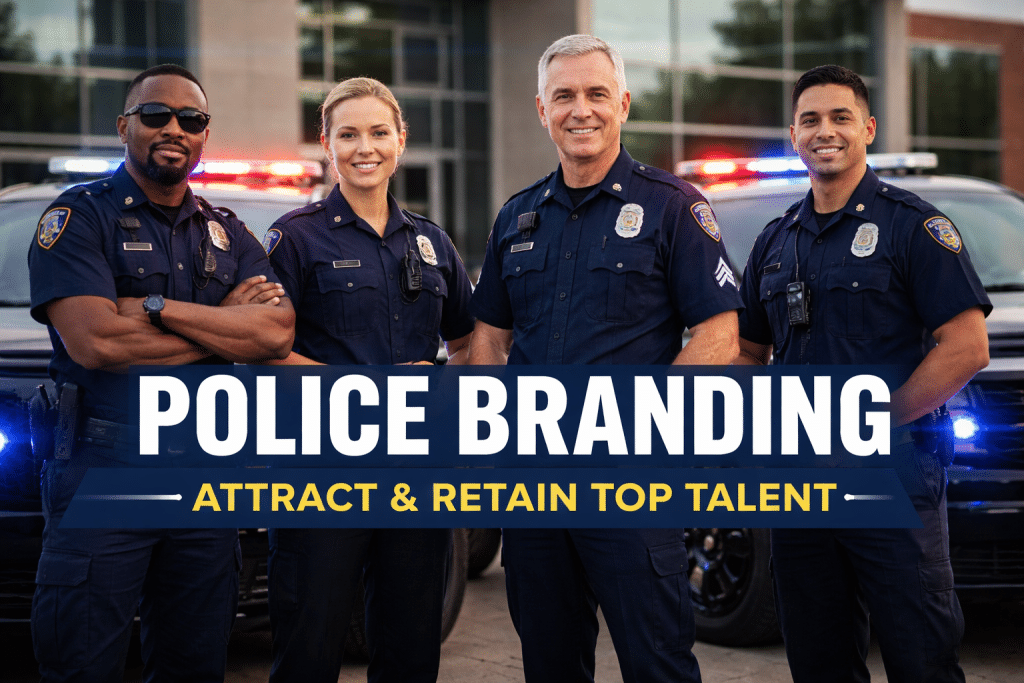
Police branding is no longer a “marketing” concept reserved for big-city departments with large budgets. It is a measurable recruiting and retention tool that shapes who applies, who stays, and how your agency is perceived when it matters most, during crisis, controversy, or rapid staffing shortages.
If your department is struggling to attract qualified applicants, branding is often the hidden variable behind poor results. And if you’re doing “recruiting” without a clear brand, you’re leaving your reputation to chance.
What Police Branding Really Means
Branding is the consistent identity your department projects to the public and to potential candidates. It’s what people believe about your agency before they ever visit your website, talk to a recruiter, or meet an officer. Branding is shaped by every touchpoint: how your officers communicate, what your social media emphasizes, how your leadership shows up, how quickly you respond to applicants, and whether your messaging aligns with the reality of your culture.
A useful way to think about this is simple: it’s your agency’s promise and proof.
The promise is what you say you stand for. The proof is what candidates and citizens see repeatedly.
Driving Recruiting Outcomes
Recruiting is a trust transaction. A candidate is considering giving your organization years of their life, their safety, their reputation, and their identity. If your police branding is unclear, inconsistent, or disconnected from reality, candidates feel it immediately.
Branding impacts recruiting in at least five direct ways:
-
Application volume: A strong brand increases inbound interest. People apply because they identify with the mission and see a future there.
-
Applicant quality: Clear branding repels poor-fit candidates and attracts those aligned with your expectations.
-
Speed of conversion: When candidates trust what they’re seeing, they move faster through your process. Confusion creates hesitation and drop-off.
-
Referrals: Officers are more likely to recommend the department when they’re proud of the identity leadership projects.
-
Retention: Branding that reflects reality strengthens a sense of belonging. Branding that oversells creates disillusionment and early exits.
Police branding either makes recruiting easier or it forces you to spend more time, money, and energy to overcome skepticism.
The Common Mistake: Confusing “Image” With “Identity”
Many agencies treat police branding like a design project: a new logo, a slogan, a recruitment video, a redesigned website. Those can help, but they are not the foundation. The foundation is operational credibility.
Police branding fails when the message says one thing and the experience says another. You can’t brand your way out of slow communication, broken hiring steps, unclear standards, weak leadership, or a culture that doesn’t match the pitch.
Candidates are not fooled by polish. They’re persuaded by consistency.
The Core Elements of Effective Police Branding
If you want police branding that improves staffing, focus on these pillars:
1) Mission clarity
Can a candidate understand what your agency values in 10 seconds? Your mission shouldn’t sound like every other department. Specific beats generic. “We serve with excellence” says nothing. “We prioritize proactive policing, training wellness, and community policing” says something.
2) Culture truth
Police branding must align with the lived experience within the agency. If you have high standards, say that. If you’re family-oriented and mentorship-driven, prove it with stories and structure.
3) Leadership visibility
Candidates watch leadership more than your recruiting unit. How your chief, command staff, and supervisors communicate creates immediate assumptions about accountability, support, and professionalism. Police branding improves when leadership shows up consistently and credibly.
4) Candidate experience
Your hiring process is part of your police branding. Long delays, silence, and confusion communicate indifference. Fast follow-up, clarity, and respectful communication communicate competence.
5) Community legitimacy
Police branding is affected by public trust. The goal is to demonstrate professionalism, transparency, and mission focus in a way the public can recognize.
Police Branding in Action: What to Publish and What to Prove
If you want police branding that attracts applicants, you need to regularly publish proof points. Here are examples that work because they reduce uncertainty:
-
A “Day in the Life” that shows reality, not a highlight reel
-
Training standards and opportunities are explained clearly
-
Mentorship structure and field training expectations
-
Career pathways: specialty units, promotions, leadership development
-
Officer stories that show why they chose the agency and why they stayed
-
Community engagement that is substantive, not staged
Police branding becomes powerful when your public narrative matches your internal standards.
How Police Branding Connects to Recruiting Marketing
Branding is the foundation. Recruiting marketing is the distribution.
Marketing can get attention. Branding earns trust. Attention without trust creates clicks, but not applicants.
This is why many departments waste money on ads: they buy traffic to a message that doesn’t feel credible, or they drive candidates to a website that doesn’t answer questions, loads slowly on mobile, or doesn’t guide the applicant to the next step.
When police branding is strong, marketing and recruiting become more efficient. You get more applications from the same spend, and better candidates from the same traffic.
A Practical Checklist
If you want a fast assessment of your police branding, answer these questions honestly:
-
Can a candidate tell what makes your agency different in 15 seconds?
-
Does your recruiting website feel modern and mobile-friendly?
-
Do you respond to a candidate inquiry within minutes or hours, not days?
-
Do your officers speak positively about leadership and culture in public?
-
Do your social media channels reflect professionalism and purpose?
-
Do you clearly explain pay, benefits, schedule, and hiring steps without forcing candidates to dig?
If you answered “no” to several of these, police branding is not an aesthetic problem, it’s a system problem.
The Bottom Line
Police branding is an operational identity made visible. When it’s clear and credible, it attracts qualified candidates, improves conversion, strengthens referrals, and supports retention. When it’s inconsistent, it creates doubt, and doubt kills applications.
If your agency wants to compete for talent in today’s market, police branding must be treated as a strategic function—not a side project.
A Case Study
We’ve helped many agencies with their overall recruiting processes, including branding. Check out the Milwaukee Police Department’s website and associated videos.
What makes this a useful example is how clearly the agency tells a story that candidates can understand quickly. You can see how the message stays consistent across the site and video content, how the visuals feel professional but not overproduced, and how the tone signals expectations. It’s not just “come work here.” It’s “here’s who we are, here’s what the job looks like, and here’s what it takes to belong here.”
As you review their content, pay attention to three things. First, clarity: do they quickly explain the role, standards, and steps to apply? Second, credibility: do the videos feel authentic, with real officers and real work, not actors and stock footage? Third, candidate experience: do they make it easy for someone to take the next step without friction?
The takeaway is simple. Strong branding is not about hype. It’s about trust. When your brand looks and sounds consistent, candidates move from interest to action faster.
Reach out to SAFEGUARD Recruiting today and let us help you brand your agency for the future.