

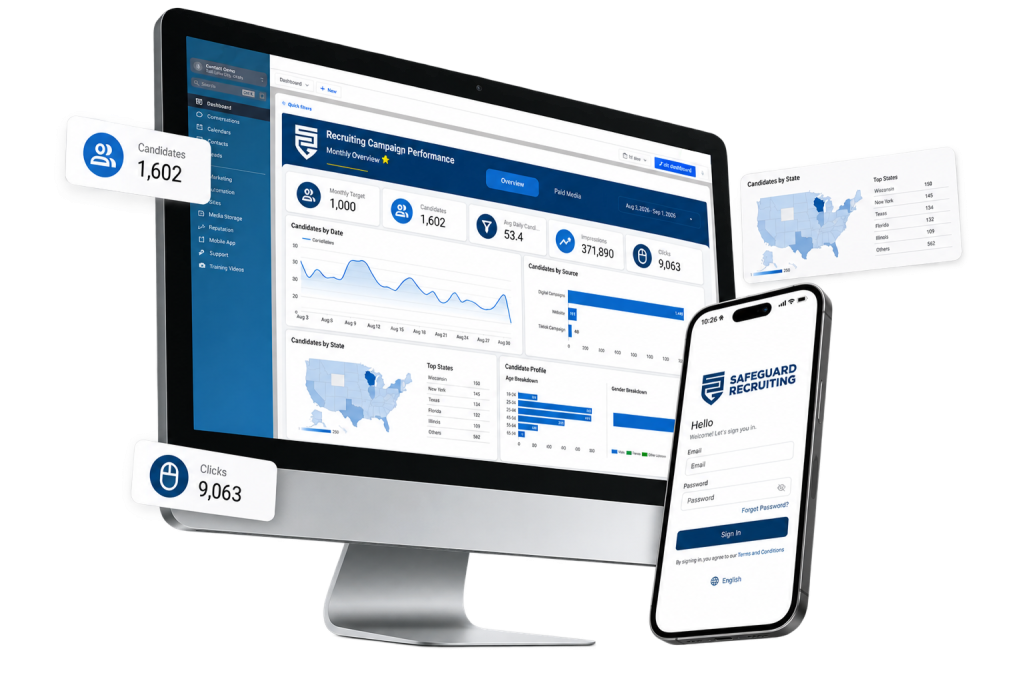
Police recruiting software can be the difference between an interested candidate who becomes an officer and one who quits your application halfway through and applies elsewhere. If your agency is short-staffed, the problem is rarely that nobody wants the job. The problem is usually that the people who raised their hand slipped through a process that was never built to catch them.
You already know the shortage is real. What most agencies underestimate is how much of that shortage is self-inflicted, created not by a lack of interest but by slow follow-up, clunky forms, and a hiring pipeline held together by spreadsheets, email, or Human Resources. Good police recruiting software fixes that part. Here is what it does and what to look for.
What police recruiting software actually is
At its core, police recruiting software captures a candidate the moment they show interest, keeps them warm, and carries them from first contact to the academy without anyone falling through the cracks.
Think of it as the plumbing behind your recruiting. The website, the videos, and the outreach bring people to the door. The software is what happens after they walk in. It grabs the lead, confirms it instantly, notifies a recruiter, tracks every step, and tells you which sources actually produce hires.
Many agencies run this on a general applicant tracking system for police departments or a purpose-built platform. Either way, the job is the same: turn interest into names, and names into sworn officers.
Why manual recruiting loses candidates
Here is the uncomfortable math. Recruitment analytics firm Appcast has reported that 92 percent of people who start an online application never finish it. A separate audit found the average online application takes roughly 51 clicks to complete.
So a strong candidate finds your agency, gets excited, clicks apply, and hits a form that asks for the same information three times and takes 45 minutes. Most of them quit. You never see their name, and you never know they were there.
Speed makes it worse. Research analyzing millions of hiring interactions found that replying just one hour slower than a competing employer cut the odds of landing that candidate by about 46 percent. Your applicant is often talking to two or three agencies at once, and they usually accept whichever real offer arrives first. When your follow up lives in a recruiter’s inbox and gets a reply next Tuesday, you have already lost.
This is the gap police recruiting software closes. It removes the friction and the delay that quietly bleed candidates out of your funnel.
The features that matter
Not every platform is worth the money. When you evaluate police staffing software, focus on the pieces that directly protect candidates from falling out of the process.
Instant lead capture and response
The best systems catch a candidate the second they submit a form and fire off an immediate confirmation. That first automated reply buys you time and tells the candidate they matter. It also alerts a recruiter to follow up while the interest is still hot.
A short, mobile friendly application
Most candidates apply from a phone. If your application is not built for a small screen and cannot be finished in a few minutes, you are handing applicants to the agency down the road. Good software lets you collect the essentials up front and gather the rest later, once the person is committed.
A pipeline you can see
A recruiter should be able to look at one screen and know exactly where every candidate stands, from new lead to background to academy. Nothing stalls in silence. Nobody gets forgotten between the phone screen and the physical test. This visibility is the foundation of any serious law enforcement recruiting strategies, because you cannot fix what you cannot see.
Reporting that ties spend to hires
This is the feature vendors love to skip. Your software should tell you how many candidates each source delivered and how many of those candidates got hired. If you can prove that community events produce three times the hires of your paid ads, you can move the budget with confidence instead of guessing.
What software does not do
Be honest about the limits. Police recruiting software is a force multiplier, not a magic wand. It will not write your outreach, build relationships in your community, or replace the officers who are your best recruiters.
The evidence is clear that personal contact drives the decision to become a cop far more than any advertisement. In a survey of 1,673 officers, researchers Richard Johnson and Matt Dolan found that fewer than 6 percent credited formal advertising with influencing their choice, while roughly 45 percent were moved by direct contact with officers in their community.
So the software works best when it supports your people, not when it replaces them. Use it to make sure the candidates your officers meet never get lost in a broken process. That combination, human contact plus a tight system, is what fills seats.
How to roll it out without disruption
Start where you are losing the most candidates. For most agencies, that is the application itself and the follow up after it. Shorten the form first. Turn on instant confirmations second. Then get every recruiter using one shared pipeline so leads stop living in personal inboxes.
You do not need to rebuild your entire hiring process on day one. Fix the biggest leak, prove the result with your new reporting, and expand from there. The agencies that win at recruiting are not the ones with the biggest budgets. They respond fast, ask little of the candidate up front, and never lose a name.
The bottom line
Your open positions are not empty because nobody wants them. They are empty because too many interested people hit friction and delay before anyone could talk to them. Police recruiting software exists to close that gap, so the effort you already spend attracting candidates actually turns into officers on patrol.
If you are ready to stop losing candidates to a slow, manual process, Safeguard Recruiting builds recruiting around what fills seats and they have developed the only applicant tracking system built specifically for public safety. Safeguard Connect enables instant follow-up, short applications, targeted outreach, and tracking every candidate in one place.
Book a call with our team and let’s turn your open positions into filled ones.
Sources (APA)
Appcast. (2024). Recruitment marketing benchmark data [As reported in Society for Human Resource Management]. https://www.shrm.org/topics-tools/news/talent-acquisition/people-92-never-finish-online-job-applications
International Association of Chiefs of Police. (2024). 2024 recruitment and retention survey results.https://www.theiacp.org/resources/research-study/2024-recruitment-retention-survey-results
Johnson, R. R., & Dolan, M. (2019). Why do people become cops? Dolan Consulting Group. https://www.dolanconsultinggroup.com/news/why-do-people-become-cops/
SUCCESS. (2025). Hiring response time: The one-hour rule that costs you. https://www.success.com/hiring-response-time-rule