

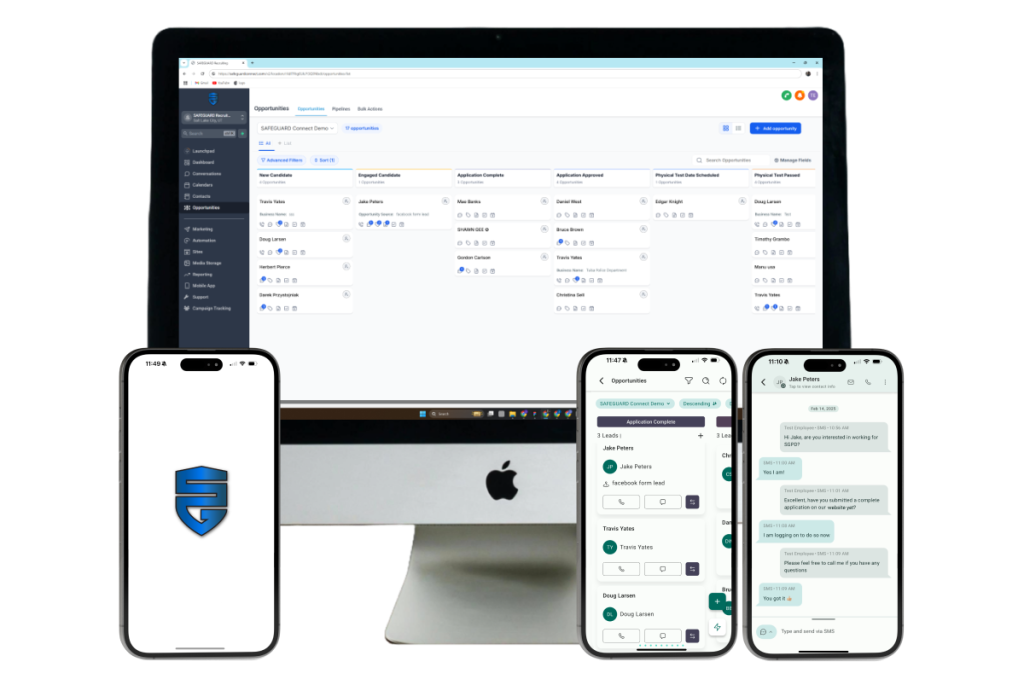
If you’re still running your law enforcement hiring process through the same software your HR department uses to onboard general workers, you already know something is wrong. Police recruiting software built specifically for public safety agencies is the difference between a process that works and one that can drive qualified candidates away.
Generic HR platforms were designed for private or public-sector employers with relatively straightforward hiring needs. Law enforcement recruiting is anything but straightforward. Polygraphs, psychological evaluations, background investigations, conditional offers, POST certification checks, and the public safety hiring process have layers that off-the-shelf HR tools simply weren’t built to manage.
This article breaks down exactly why purpose-built police recruiting software outperforms generic HR products, and what agencies should look for when they’re ready to upgrade.
The Core Problem: Law Enforcement Hiring Is Not a Standard HR Function
The average hire takes 23 to 44 days. Law enforcement hiring, by contrast, routinely takes six months to a year from application to academy date. The reasons are structural, background checks, medical screenings, psychological evaluations, and civil service requirements layer complexity on top of complexity. Generic applicant tracking systems weren’t designed to accommodate that kind of timeline or that many interdependent steps.
When your ATS can’t track a candidate through a conditional offer pending background investigation while simultaneously queuing them for a polygraph, your recruiters end up managing the gaps manually in spreadsheets, in email chains, in sticky notes.
The PERF 2023 staffing survey found that nearly 80% of agencies reported difficulty filling sworn officer positions. Losing candidates to process friction, delays, confusing communication, and lost paperwork is a problem agencies simply can’t afford. Effective law enforcement recruiting strategies start with the right infrastructure in place.
What Generic HR Software Gets Wrong for Law Enforcement
1. Workflow Inflexibility
Off-the-shelf ATS platforms are built around a standard hire-to-onboard pipeline: application, interview, offer, done. That workflow doesn’t exist in law enforcement. Agencies need to track steps such as written exam completion, agility test scores, medical clearance, polygraph results, background status, and academy enrollment, all of which can occur in different sequences depending on candidate type and agency policy.
Generic tools force recruiters to shoehorn law enforcement hiring into a corporate framework. The result is a broken workflow that creates confusion for both recruiters and candidates.
2. No Support for Compliance and Civil Service Requirements
Public sector hiring operates under civil service rules, union agreements, veterans’ preference laws, and POST requirements that vary by state. A generic HR platform has no awareness of any of this. There’s no mechanism to track veterans’ preference points, flag residency requirements, or ensure that hiring decisions are documented in a way that can withstand a civil service appeal.
Purpose-built police recruiting software is designed with these constraints in mind from the ground up, not bolted on as an afterthought.
3. Poor Candidate Experience
Today’s candidates, including Millennials and Gen Z applicants who make up a growing portion of the applicant pool, expect a clean, mobile-friendly, communicative experience. Generic HR platforms often produce clunky portals designed for desktop-first enterprise users, not for candidates checking their application status on a phone while working a second job.
Research consistently shows that applicants who have a negative hiring experience tell others. In a recruiting environment where referrals and word-of-mouth still drive a significant share of applicants, that matters.
4. Limited Reporting and Analytics
Generic HR software typically offers reporting built for corporate KPIs: time-to-fill, cost-per-hire, and headcount. Law enforcement recruiters need different data: application-to-academy conversion rates, attrition points in the hiring pipeline, demographics reporting for EEOC compliance, and source tracking to understand which recruiting channels actually produce certified officers.
Without the right reporting, agencies can’t identify where they’re losing candidates or make informed decisions about where to invest their limited recruiting budget.
What Purpose-Built Police Recruiting Software Does Differently
Purpose-built platforms for law enforcement aren’t just generic ATS tools with a badge slapped on the login page. The best ones are built by people who understand the public safety hiring lifecycle from application to badge and they show it in the details.
Customizable Multi-Stage Hiring Pipelines
A purpose-built platform lets your agency define its own hiring stages and sequence them to match your actual process. Conditional offers, background investigation queues, medical hold statuses, and disqualification reasons are all first-class features, not workarounds. Recruiters see exactly where every candidate stands at every stage without opening a single spreadsheet.
Automated Communication and Follow-Up
One of the top reasons candidates drop out of law enforcement hiring processes is a lack of communication. They apply, they wait, they hear nothing, they move on. Purpose-built police recruiting software includes automated touchpoints, status updates, next-step instructions, and document collection reminders that keep candidates engaged without adding to a recruiter’s already-heavy workload.
Lateral Recruit Tracking
Lateral recruiting has become one of the most important tools available to agencies trying to fill sworn positions quickly. A good platform differentiates lateral applicants from entry-level applicants and supports the condensed hiring process that laterals typically go through. This is something generic HR tools almost universally fail to accommodate.
Compliance-Ready Reporting
Built-in EEOC reporting, veterans’ preference tracking, and audit trails mean your agency isn’t scrambling to reconstruct records when a hiring decision gets challenged. The documentation is automatically stored in the system.
What to Look for When Evaluating Police Recruiting Software
Not every platform that markets itself to law enforcement actually delivers on the promise. Here’s what to evaluate during your selection process:
- Police recruiting software is built by or with active input from law enforcement recruiting professionals, not adapted from a corporate HR template
- Police recruiting software has configurable hiring stages that match your agency’s actual process, not a generic pipeline
- Mobile-optimized candidate portal with clear status visibility and document upload
- Police recruiting software will have automated communication tools with customizable triggers for each hiring stage
- Police recruiting software will have robust reporting that covers pipeline analytics, source tracking, and compliance documentation
- Police recruiting software will support for both entry-level and lateral applicant tracks
- Integration capability with background check vendors, civil service testing platforms, and your HRIS
If a platform can’t clearly answer how it handles conditional offers pending background investigations, or how it tracks lateral versus entry-level applicants differently, that’s a sign it was built for corporate HR, and it clearly should not be used as police recruiting software.
The Real Cost of Using the Wrong Tool
It’s tempting to think that using the HR platform your city or county already pays for is the budget-conscious choice. But consider the full cost: recruiter hours spent maintaining manual tracking systems, candidates lost to poor communication, compliance exposure from inadequate documentation, and an inability to identify and fix the specific stages where your pipeline breaks down.
When an agency loses a quality candidate six months into the hiring process, after polygraph, psych eval, and a partial background investigation, the cost of that loss in recruiter time alone often exceeds the annual cost of purpose-built police recruiting software.
The IACP has repeatedly documented that the agencies gaining ground in the current recruiting crisis are the ones investing in infrastructure, tools, processes, and people, not the ones trying to make do with what they have.
The Bottom Line
Law enforcement recruiting is a specialized discipline with specialized needs. Generic HR software wasn’t built for a six- to twelve-month hiring pipeline, civil service compliance, polygraphs, or lateral officer onboarding. Purpose-built police recruiting software closes that gap, not just in features, but in the recruiting outcomes that actually matter: more qualified candidates reaching the academy, fewer dropping out along the way, and a recruiter team that spends time building relationships instead of chasing paperwork.
If your agency is ready to stop working around your tools and start working with them, the first step is an honest assessment of what your current system can—and can’t—actually do.
Ready to See What Purpose-Built Recruiting Looks Like?
Safeguard Recruiting was built specifically for law enforcement agencies navigating today’s recruiting challenges. From customizable hiring pipelines to automated candidate communication and compliance-ready reporting, our platform is built for how public safety recruiting works, not how corporate HR does.
Visit safeguardrecruiting.com to learn more or schedule a demo with our team.