


Police recruitment is no longer won by who shows up at the most job fairs or posts the coolest tactical-cool video. Police recruitment is won by the agency that removes friction, answers real questions fast, and makes it easy for qualified people to take the next step. In 2026 and beyond, that happens on your website.
If your recruiting website is outdated, slow, confusing, or built like a press release archive, you are losing candidates every day. Not because they were never interested, but because your site made the process feel unclear, inconvenient, or not worth the effort. A great recruiter can’t overcome a broken digital front door. And the truth is simple: your website is working 24/7, whether it’s helping or hurting police recruitment.
Your website is the first interview
Most candidates will interact with your agency online before they ever talk to a recruiter. They will visit your site from a phone. They will scan. They will click once or twice. And they will decide quickly.
Tip: Have you clicked on your website (on a phone) once or twice? If you have to keep clicking to submit your information, you are losing candidates and applicants.
That means police recruitment depends on a website that communicates three things immediately.
Who you are
What the job looks like
What they should do next
If any of those are unclear, candidates leave. And when they do, they rarely come back.
A recruiting website reduces drop-off and increases qualified action
Police recruitment is not only about awareness. It’s about conversion. You can run ads, post on social media, and get attention, but if the website experience is weak, that attention amounts to nothing.
A high-performing recruiting website increases recruitment because it is designed for action, not just information. It moves the candidate from curiosity to commitment. It captures interest even when they are not ready to apply today.
That happens when your site includes clear paths like:
Apply now
Talk to a recruiter
See requirements
Pay and benefits
Hiring process timeline
Next testing date
Register for an event
These are not “nice to have” pages. They are the pages that answer the questions that determine whether a qualified candidate takes the next step or backs out.
We recently helped the Philadelphia Police Department optimize its current recruiting website.

What do you notice?
This is at the top of the page, and it’s urgent! As soon as someone clicks on the button, the candidate sees this:
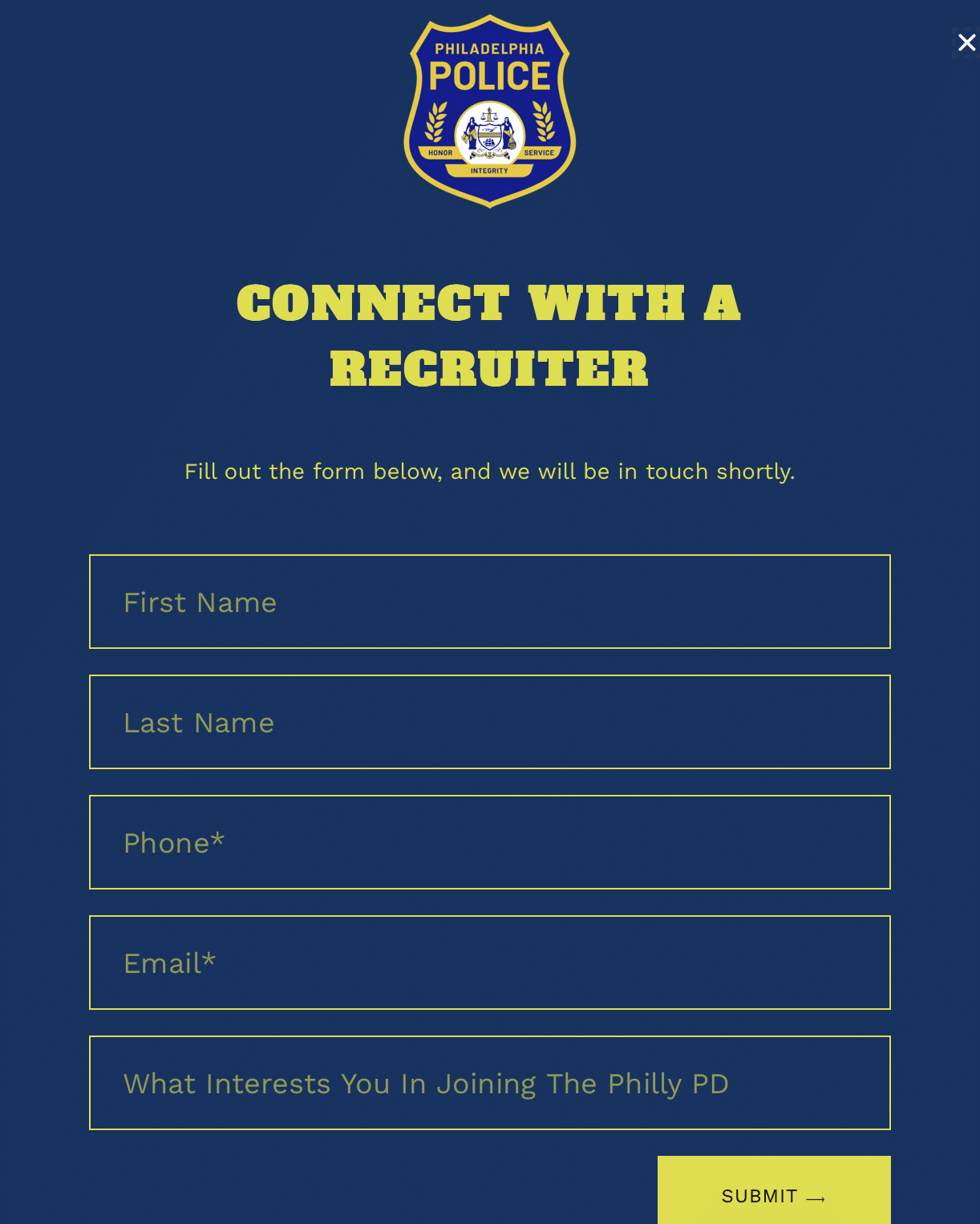
Within a few seconds, the agency has the name, and they can immediately begin speaking to them to take the next step.
Mobile experience is everything
Police recruitment lives on mobile. Candidates are not sitting at a desktop computer studying your site like a research paper. They are checking it on a lunch break, between calls, or at night when they finally have time. If your site is slow, hard to read, or forces them to pinch and zoom, police recruitment suffers immediately. Even worse, the candidate assumes your agency is behind the times. That perception matters more than many leaders want to admit.
A mobile-first site should load quickly, use large, readable text, and keep buttons easy to tap. Application steps should be simple and obvious. If the application is long, the site should offer an alternative path, such as a short interest form that starts the conversation without forcing a full commitment on the first visit.
Search engine visibility (SEO) is free recruiting
Police recruitment should not rely only on paid ads. The best candidates often search phrases like:
police jobs near me
how to become a police officer in my state
police officer pay and benefits
police department hiring process
If your recruiting pages are not optimized, you miss those searches. If they are optimized, you gain consistent traffic without paying for every click.
SEO is not magic. It is structure and relevance. Your site needs recruiting-focused page titles, clear headings, and content that matches what candidates actually search. It also needs your agency name, location, and service area clearly stated so Google understands where you belong.
When your website ranks, police recruitment gains momentum because you are found by people who are already interested.
Speed and simplicity increase completion rates
Every extra step hurts police recruitment. Every unclear instruction creates hesitation. Every broken link creates doubt.
A good recruiting website is built around one principle: reduce friction.
That means fast load times, simple navigation, and a clean path to action on every page. It also means forms that work, confirmation messages that reassure the candidate, and follow-up that happens quickly after they submit.
Police recruitment is emotional. Candidates want to feel welcomed and respected. A smooth website experience communicates professionalism before a recruiter ever makes contact.
Conclusion
Police recruitment is not failing because people don’t want the job. Police recruitment is failing when agencies make it hard to understand the job, hard to trust the process, and hard to take the next step.
Your recruiting website is your first impression, your best filter, and your most consistent recruiter. If it is built to convert, police recruitment improves. If it is built to simply exist, police recruitment stalls while you spend more money trying to make up for what the site should be doing for free.
If you want to improve police recruitment quickly, start with your website. Safeguard Recruiting helps agencies identify the exact website issues that cause drop-offs and missed applicants, then fix the friction points that quietly sabotage recruiting results.
Contact us, and we will provide a free audit along with suggestions to improve your recruiting today.