
As baby boomer officers and firefighters retire, public safety agencies are scrambling to fill the ranks with Millennials and Generation Z, making effective police recruitment more important than ever.
Often, Chiefs and command staff express frustration: “These young people don’t want to work,” or “They don’t have the attention span for the process.”
The truth is harder to swallow: the problem isn’t the generation; it’s the process. You cannot recruit a 22-year-old whose entire life is on a smartphone using a process designed in 1995. To revolutionize police recruiting and attract the next generation of first responders, your agency must prioritize the “Candidate Experience.”
Police Recruitment: Speed is the New Currency
Gen Z is used to instant gratification, from ordering food to consuming media. A hiring process that starts with a six-week silence after an application submission is alien to them. They interpret slow responses as disinterest or incompetence on the agency’s part.
If you want to engage younger recruits and revolutionize police recruiting, your initial response time needs to be measured in hours, not days.
Why Texting Rules Everything
If you email a 23-year-old applicant to schedule their oral board interview, there is a high probability they won’t see it for days, if at all.
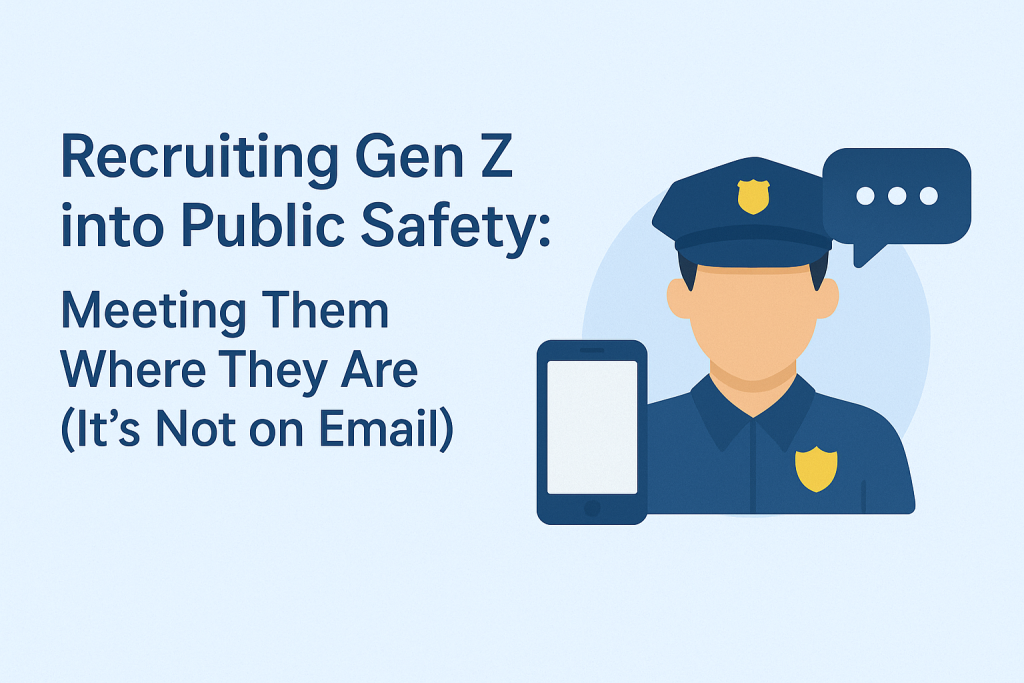
Email is seen as a formal, slow communication channel by younger generations. Text messaging (SMS) is their primary mode of communication. It’s immediate, personal, and sits right on their home screen.
Agencies that use police recruitment software to send automated text updates on application status, test reminders, and academy information see significantly higher engagement rates than those relying solely on email and phone calls.
Transparency Builds Trust
The public safety hiring process is intimidating, invasive, and long. Gen Z values transparency highly. Don’t keep them in the dark.
Use your police recruiting tools to provide a clear roadmap of the process. Send them automated updates like: “You are currently at Step 3 of 7: The Background Investigation. The average time for this step is 4 weeks. We will check in again next Tuesday.”
This level of proactive communication eases anxiety and builds trust in your agency before they even put on a uniform.
Conclusion
Public safety agencies don’t have a “young people” problem. They have a systems problem. Millennials and Generation Z will absolutely commit to hard, meaningful work when the process respects their time, communicates clearly, and proves the agency is competent and worth joining. The reality is simple: if your police recruitment process feels confusing, slow, and silent, you are selecting for only the most persistent applicants, not the best ones. Everyone else will interpret friction as a warning sign and move on.
The agencies that will win the next decade won’t be the ones with the biggest signing bonus or the flashiest video. They’ll be the ones to build a candidate experience that mirrors how people live today: mobile-first, fast, transparent, and human. That means an immediate response when someone raises their hand. It means SMS updates that keep prospects engaged without forcing them to chase you. It means giving applicants a clear roadmap, predictable timelines, and proactive check-ins so they aren’t left guessing for weeks. And it means using recruiting software not as a gimmick, but as an infrastructure that frees recruiters to do what only humans can do: build trust, answer questions, and assess character.
This is also a leadership issue. If the command staff treats police recruitment like a side project, the process will stay broken. If leaders set a nonnegotiable standard for speed, clarity, and candidate care, recruiting becomes a culture signal: “This agency values people and executes well.” That is exactly what the next generation is looking for.
If your hiring process is stuck in the past, don’t blame the applicant pool. Fix the pipeline. SAFEGUARD Recruiting helps agencies modernize their recruiting systems, shorten response times, and build mobile-first candidate journeys that convert interest into applicants, and applicants into hires.